
(This article is part of an ongoing series on in-home food storage. Read the previous installment here.)
To begin building your at-home food store, walk through your home taking a fresh look at your household goods as being supplies for your in-home convenience store. Maybe you don’t have a year’s supply of food yet, but you might have a considerable supply of seasonings and lots of certain canned goods or packaged mixes.
Check out your equipment. What tools do you have for cooking and baking? Do you have camping gear—equipment that might be used for emergencies? An old lunch box makes a very good container for first aid supplies. What items do you have in the bathroom drawers and in the kitchen cabinets that might go into a first aid kit? Remember the last time you had fast food and threw away the plastic utensils in the plastic sleeve without a care?
What about keeping those for your in-home storage in case you don’t have enough water for washing dishes. Picnic supplies may come in handy, too. Emptied plastic soda bottles work well for storing emergency drinking water for short periods of time. Get boxes and begin sorting storage items as you find them. Make the best use of things you already have. Most people are surprised to find how much they have on hand already. You’ll soon realize that preparedness is really a matter of awareness of what you have on hand to solve the problem when the need arises.
Store What You Eat
The most important part of an in-home storage plan is knowing what you eat now and buying what you’ll most likely eat in the future. Having a store full of items you don’t use or need makes your in-home convenience store somewhat of an inconvenience store! It’s truly wasted time, money, and effort if the food stored does not appeal to the family’s taste.
This is an excellent time to review carefully your eating habits—becoming even more aware of the “good†foods your family eats as well as the snacks, treats, drinks, and other “junk†foods to which they’ve become attached. It is also a great teaching moment for parents to urge children (of all ages!) to cut back on all sorts of unhealthy foods, especially since they don’t usually store well, as a general rule. It’s a good idea to begin to limit your purchases of prepared foods, too.
You manage your in-home pantry in a similar fashion to the local grocery store—as items are stocked, place them behind the goods already on the shelf. As you acquire items for your in-home convenience store, date them so you’ll know which was purchased first. Items with shorter shelf life may be noted and dated “Use by: _______†to assure utilization within their useful shelf life period. Restock as items are used. Obviously, you will not restock food items not favored by your family. Managing the rotation of all food items will be much easier if you have stored foods that family members are interested in eating.
Inventory management for a basic in-home convenience store is very simple—and hopefully, by now, very familiar:  Store what you eat. Eat what you store. Use it or lose it!
It’s really as simple as that!   It’s the Basics K.I.S.S. theory: Keep It Super Simple!
Purchase the “Essentials†First
Realistically, given the need to allocate your financial resources to more areas of your life than just purchasing storage supplies, it becomes critically important to have a way to determine what to buy first, so in this edition we provide you some guidelines with a series of Shopping Lists–or Quick-Lists that eliminate the guesswork and facilitate your decision-making . As noted, essential items have been selected because of their contribution to sustaining life in a reasonably normal and healthy manner, for enhancing variety in meal selection, and to supporting greater utility of the other stored items.
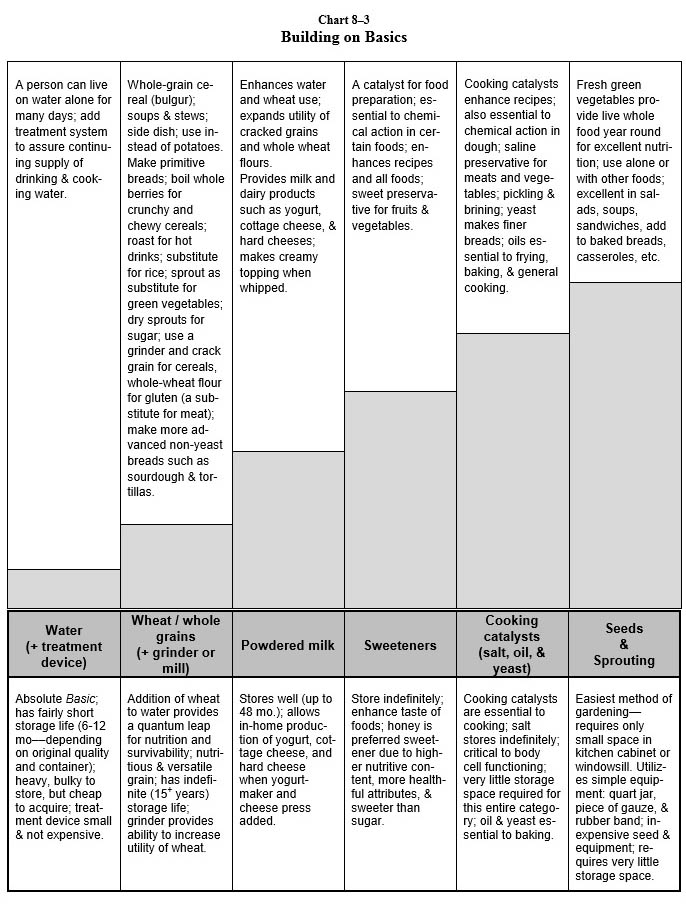
Use the Shopping List as a guide to the most useful purchases for your storage supply. If the only items acquired for in-home storage were the essentials, you would have a life- and health-sustaining diet.
The advantages of employing the Shopping List are that the lists:
- provide you with a ready-made plan until you gain experience to design your own
- allow you to acquire storage items in an orderly and systematic manner—one at a time—and consistent with your income
- facilitate storing supplies from all categories—insuring greater self-sufficiency
- permit flexibility—can be modified to meet your personal needs
Determine Manageable Time Units
The process of gathering a year’s supply can be accomplished more easily if the effort is broken into smaller parts. Do this by setting up time units in which to accomplish certain interim objectives or stopping places on your journey. Determine the block(s) of time in which you function most comfortably.
If you’re oriented to a week-at-a-time schedule, then plan to store 52 one-week quantities. If you organized on a monthly basis, then plan for 12 one-month quantities—or as we call it in today’s parlance—installments.
Time units are a good method to relate to your acquisition plan. Once you’ve decided what to buy, merely divide the family’s storage requirements by whatever time unit(s) your family chooses, then buy the item(s) in installments. Make the calendar and time work for you!
Chart Your Progress
There are no deadlines other than those you establish for yourself, and they are only in relationship to your own circumstances. Any progress you make is success––defined as progressive realization of a worthy goal! Put a chart on your wall for your family to see the progress being made.
This chart below can also serve to display the range and balance of items stored, helping avoid imbalances (for example: 6 week’s/month’s worth of powdered milk, only 1 week/month of wheat, and no water for making milk or bread!)
This is an example of a chart you could make and place on a wall or on the most noticeable place––the refrigerator door! Use colored pens or crayon to show your on-hand position versus your storage needs.
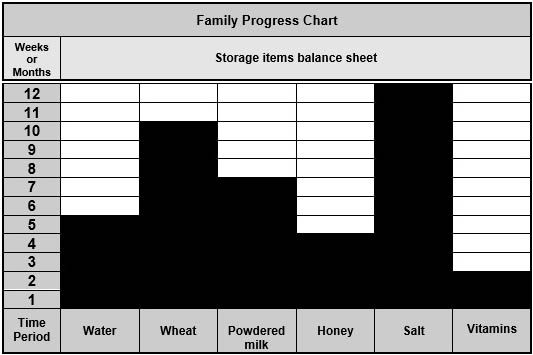
Charting your progress will remind you of your family’s achievements in your in-home convenience store acquisition plan and gives you encouragement on your journey.
The above article was taken from Dr. Prepper’s Making the Best of the Basics by James Stevens, which is now available to Survival Life readers at half-price. Just click here and enter coupon code present to get your copy for only $19.97!
Food Storage | Guidelines For Stocking Your Pantry
Food Storage | Guidelines For Stocking Your Pantry
#shtf

No comments:
Post a Comment